Has  Australia’s Central Coast of New south wWales, had visitors from Egypt 5000 years ago, and did it effect Egyptian history?


Acknowledging the early Egyptian visits to Australia and our first people’s memory on the Central Coast of a tragedy that befell our visitors from Egypt to our land, and how it had an impact on the ancient Egyptians and Egyptian royal succession5000 years ago. 

This letter is in response to the paper by Dr. R.M. de Jonge Oct. 2014, on the subject of the Gosford glyphs, to encourage more research into the true history of the Central Coast

The paper is:- entitled Burial Site of LORD Nefer-ti-ru, son of King Khufu.: c. 2637BC-2614 BC fourth dynasty of Egypt (Gosford NSW, Australia)

Dear Dr. Jonge,

I would like to thank you for research on the Gosford Glyphs, which fills in some of the details of this particular visit, we believe the ancient Egyptians visited Australia’s Central Coast, which had a tragic ending and filled in some of stories inscribed on the rock walls that you  had presented as fact according to the reading of the Egyptian hieroglyphs found inscribed on several rock faces on the southern parts of the Central Coast of New South Wales near Gosford NSW.

I would like to build a case, for a set of circumstances that could have happened  for the validation of the account presented by you and the stories of the site being, one of the first contacts sites near the, proposed burial site for the visitor from the middle east in antiquity, and their unfortunate circumstances in New South Wales.

By using the local knowledge of the locations around the Brisbane Waters to understand how the stories translated from the sandstone wall could be a true account of the events 5000 years ago in Brisbane Waters.

I am a member of the Habitat Association, we are a small group of interested academics and researchers, who have an interest the mechanisms of settlement, and in particular on the Australian Central coast of New South Wales, we would like to find some solid scientific proof that the site was infact constructed by a group of ancient Egyptians and clarify the enigma of the site.

There is some contradictions as to the age of the site, the inscriptions suggest that the site is 5000 years old but , other histories related to the technology at hand 500 years ago might suggest that site is only 500 years old, some archaeological investigations, would help to answer this question, and many other questions about the site. 

The habitat Association, is a group of members, who are interested, in original thought, who, research as members of the group who are professional people, with backgrounds in town planning and ecology, who have an interest in human habitats, settlement and their, their interactions in the environment and their movements over time, have been focused over last 12 years of the organisation’s life has been on the environs of the New South Waled, Central coast and Newcastle areas north of the Australian Capital city of Sydney.

We think we might be able to use our knowledge of human movement patterns by using local knowledge as several of our members have lived in several locations around the possible passage of the visitors into the Brisbane Waters. One of our members has kayaked around Broken Bay to the site near “The Spike Milligan’s Bridge”, an realises the ease the Egyptians explorers would have found to get to this sheltered anchorage at park Bay, near Woy Woy, bearing in mind 5000 year ago the railway causeway and bridge, that was not constructed until 1930, and would not have been there nor would the row of houses along the beach, one of which conceals the trail from the beach to the glyph site, which, was the clue to story of the landing place, the trail may have been destroyed over the years by the housing development but remains on the google maps.

We feel that there is enough topographical evidence to the site, and enough, Egyptian history relating to Pharoah Khufu to consider the glyphs genuine.

There has been a lot of local talk about the glyph being a hoax, however, there has been no scientific proof presented that it is a hoax.

On the basis of the balance of probability with topographical evidence supporting the glyphs interpretation made in your paper and the habitat Associations conclusions, below, we feel on the balance of probability the site is genuine.

The habitat Association would like to see further scientific study of the site and appropriate archelogy being carried out, of the site to prove the site is an important site for the history our Land of Australia to give a more complete history of the indigenous peoples of the region of the Central Coast of new South Wales.

A recommendation for a Scientific study be made to find answers, should include the following research points, the following research would contribute to the validation of the site as genuine.

  • The red ochre found on the possible burial site should be analysed to see if the ochre was locally acquired, the implication to locally acquired ochre is that it confirms the glyphs account, of cooperation between the local peoples and the text on the rocks indicates that there was co-operative trade on the Central Coast between the local peoples and the Egyptian visitors.
  • The beach where, we have indicated that the visitor landed, would have been camp for a possible two trimesters, which is about eight months, indicated in the text of the glyphs, if this is so, bones and other artifacts could be found in the sands of and lower parts of the cliffs leading up to the site. From these fragments, the scientist can estimate dates if the deposits, by using carbon dating.
  • On interpreting the burial customs of the Egyptians at the time to old kingdom of deductions can be made to the likely location of any Royal body at the site, due to unfortunate circumstances of a snake bite to one of the expedition leaders, who was recorded on the text of the glyphs as a prince of Egypt. , deduction can be made to the location of other bodies that may have needed a proper burial, from the accident at sea from the story on the glyphs that relate to the upturning of one of the boats and return to the south to Broken Bay, Where lives seen to have been lost.
  • Identify whether the boomerangs found in Tutankhamun’s tomb, to be pronominally from the east or west coast of Australia, if they are found to come from the east Coast of New south Wales, this would add further data to the sites Genuineness.

This letter is in response to the paper by Dr. R.M. de Jonge Oct. 2014, about the Gosford glyphs and to encourage more research into the true history of the Central Coast

the paper is entitled Burial Site of LORD NEfer-ti-ru, son of King Khufu.: c. 2637BC-2614 BC fourth dynasty of Egypt (Gosford NSW, Australia)

Why is the Habitat Association interested in the enigma of the site?

The Habitat Association has been interested in the preservation of natural areas, and has been active preserving a wildlife corridor near the Tuggerah lakes, which is believed to be a meeting place in antiquity of aboriginal peoples from many region around the New South Wales, were the culture of storytelling would have been practiced in an environment around lagoons, and the lake, in atmosphere of trade and hunting and food gathering from the lake and surrounding bushlands, unfortunately the pristine meeting place was destroyed several years ago and housing estates, sit on much of the sites that has not been preserved, by a wildlife corridor at Wadalba, which sites on a hill that is prominent in the landscape, which would draw the aboriginal peoples in to the meeting place.

The habitat Association, its research as members, who are professional town planners and ecologists, who have an interest in human habitats and their movement over time.

LORD NEFER-TI-RU was the son of a fourth dynasty an Egyptian Pharoah Khufu, WHO may have travelled to Australia 5000 years ago, and died as the result of snake bit in the Australian bush or by the events of a storm in the coastal waters off Broken Bay near Gosford, The story written on the Gosford glyphs rockfaces indicate that he was buried by, his brother, and the ship’s crew in a remote location, in New South Wales near the city of Gosford. The Egyptian record of this son is that he had lost his live, prior to the death of his father and was not alive to take the throne of Khufu when he died, a younger brother took his place as explained below.

In this article we revaluate the story and attempt to flesh out the story in the context of the location of the site, the Brisbane Waters National Park in the mountains east of the Central Coast of New South Wales Australia.

We hope to flesh out the Research put forward by Dr. DeJonge and look at peripheral information about the location of the burial site and possibly build a case for the presence of the Egyptians in Australia in ancient times.

Over the last 50 years there has been considerable, conjecture about the validity of the story of the Glyphs, written on the sandstone in the Brisbane Waters National Park, just outside the Central Coast regional town of Kariong, a suburban area of Gosford.

Firstly, is it plausible that the ancient Egyptian peoples could have travelled to the Central Coast’s region of New South Wales in 3000BC? 

Pharoah KHUFU demonstrates the possible technology of boat construction with a boat reconstructed outside the great pyramid with a length of 46 metres. Therefore, it is conceivable that larger boats could have been built and been employed to make a journey to Australia along the coastlines of Arabia, India, Indonesia and New Guinea.

In Dr. Jonge’s paper, he notes that the Egyptian expedition leader noted the land just south of New Guinea as a new land at a point now called Cape York Australia.

It might be worth noting to get to Australia from Egypt, you would follow the coasts of Indian and Indonesia, predominantly, without crossing large portions of ocean, as the ships available from Egypt may not have been very capable of operating in heavy seas.

This is borne out by one of the stories on the Gosford glyphs, which tells of a group of one or more ships leaving Broken Bay near the probable Egyptian settlement near the regional town of Woy Woy.

The settlement was adjacent to the Spike Milligan’s Railway bridge, were 5000 years ago a small sandy beach would have enticed weary travels to land within the waters of Brisbane Waters know to the native peoples as Way Way meaning ‘deep waters’ inside an  estuary entered from Broken Bay a large expansion of water open to the Pacific ocean which was the mouth of the mighty Hawkesbury River, then by taking the northern arm as described by Captain Phillip, the first Governor of the Port Jackson colony, Sydney, who was from the fledgling settlement of the Europeans in Australia in 1788  as the north arm, entered into the Brisbane Waters, and past the half tide rocks meander of the channel and then negotiate the Rip, which is often an area of fast moving and choppy waters as you enter the deeper water in the estuary near Woy Woy, crossing from Woy Woy’s brick wharf constructed to off load bricks for the construction of a rail tunnel, constructed in the early twentieth century.

As the Egyptian fleet sailed past the wharf area it would have simply sailed north up the Brisbane Waters to the small beach in a small, sheltered bay opening out into the inner waters of the Brisbane Waters near the the locations of Woy Way and Waterfall Bay of today.

The beach is pivotal to the site of the burial of one of the Princes of Egypt in that there is a trail from the beach up the hill to Bambara Road which extends from the burial site to a main road , which continues to be the main Road from Kariong to Woy Woy.

It is assumed that the ancient peoples used this trail to access and work on the site, and many first peoples rock carving site along this road, used to give instructions,  to visitors, and other native peoples the availability of game to hunt in the area.


The enigma of the Glyphs presents conditions of settlement, that should not be dissimilar from other norms of settlement.

As we analyse the story of the Glyphs, we recognise that the Egyptians could have simply followed the coastline of the east coast of Australia with one addition, that we will investigate later in the paper,( the theory that the Central Queensland town of Gympie was another Egyptian settlement around the same time).

The question is, how did the small camp of the Egyptians in Brisbane Waters get extra food and fresh water., being on a salt water estuary, water was not readily available, and according to the Glyphs story, the landscape was dry and, insect would bite regularly .this is the story today if you were to camp there today , where would you find fresh water?, water was available in the Bay to the west of the camp, at the end of the bay called Waterfall Bay there is a stream flowing from the sandstone rock ground water, alternatively, if they were told by the native peopled you can dig into the sandy beach five or six metres and collect freshwater potable water even though you are in a salt sea environment, this is how many of the modern residents of Woy Woy get their water.

What food resources were around, for the small Egyptian settlement, there was a small peninsula where they landed called Koolewong, the local aboriginal name for koala.

To the modern day Australian, Koalas are  not thought as a food source and in fact koala is a protected species and rare in the area, but 5000 years ago they may have been plentiful in the local scribbly gums, grey gums and manna gums forests of Brisbane Waters, to a desperate settlement koala would have been on the menu, koala habitat is known to extent to the south and west of the site and throughout the Brisbane waters national park.

 The whole estuary was covered with promotively Sydney rock and a few Pacific oysters, which could have been harvested by the Egyptians, today the pelican population is artificially high, due the regular afternoon feeding of the birds by the fish co-op at Woy Woy ,at brick wharf Road as an tourist attraction, 5000 years ago, pelican could have been on the menu, not to mention  the fish stocks in the Brisbane Waters would have been plentiful for netting in those days.

Native people contact would have regulator and indications are that contact was friendly, according to the sum of the text of the Rock inscriptions at the site. 

When red Ochre was required to build the burial site, it would have been obtained from local native peoples, who would have obtained it from, Lake Munmorah area some 40 kilometre to the North, through a possible aboriginal trading network from the Lake Munmorah’s coastal cliffs, which were the closest location to get this commodity.

Local native carvings were close by, near the intersection of Barbara Road trail and the Woy Woy trail Aboriginal trail or Woy Woy Road today, from the site of these rock carvings the Egyptians would have been about to see a prominent mountain to the south shaped like a pyramid (mount Wandabyne), viewed from the west it loses its pyramid shape but is a steep sided flat top mountain.

It seems that the second son of Khufu’s son Lord nefer-Djesrb  was supervising the building of the burial site after the returning ships brought the bodies of those who lost their lives during the short open sea expedition of one or more ships attempted to start a journey to the north up the coast towards their homeland, bodies of dead seem to have been recovered and buried at the site near Kariong. The first-born son seemed to return alive, back from the devastating storm that capsized the unseaworthy, boat or boats off the coast of the new South Wales coast.

In walking back and forth up the bush track it is easy to understand how you might meet a deadly red belly back snake, no Australian native, nor would any Australian today walk in the bush bare foot in the summer without first checking where he stepped and would wear shoes.

Snakes and bush flies are two of the hazards of the Australian bush along with mosquitos, these hazards are described in the text of the Gosford glyphs, which helps it to become a credible account of the story of long ago.

The Egyptian explorers may have not strictly followed the eastern coastline of Australia as they travelled to their possible base in the Brisbane waters of New south Wales, this is because when we consider the story from the Glyphs about the rough weather encounter on  one of the returning expeditions from Broken Bay , which founded in the seas off the coast of new south Wales with horrific loss of life including, possibly, one of the sons of KHUFU, wE have to recognize that these boats were not deep drafted vessels that could handle heavy seas.

When we consider the method of travel from Egypt, it is possible that they sailed close to the coast deliberately, and hugged the coast all the way from Egypt with some short trips across open water for a day or two.

This is why they were nervous about going to far out to sea, as they travelled down the east coast they would have encountered a land obstacle that would have required them to go out to sea .as they followed the coast they would have been choraled down the west side of Fraser Island, (K’gari) and into Tin Can Bay ,then they would have landed in Tin Can Bay, travelled over land towards the regional town of today called Gympie. There they would have seen a pyramid shaped mountain, and perhaps seen this as as a sign to set up a settlement as on the Brisbane waters.

It wouldn’t have been long before they realised that the place was rich in the mineral gold. And started to mine the precious metal. 

In those days their Gods expected the people to mine gold and offer as much as possible to the Gods, so there would have been a tremendous incentive to mine that which was easily, to be obtained at that locality, this would have meant that a small settlement would grow up , however in Brisbane waters there is no gold to be mined in the wholly sandstone geology of the Central Coast of New South Wales.

It is recorded in other Egyptian stories that the gold found in tomb of Tutankhamen was from the Antipodes( an ancient reference to Australia from those times, along with the boomerangs found in the tomb, the antipodes was the ancient Egyptian name for a country on the other side of the globe, which in effect was the country later to be named Australia. 

Trade would have happened between the native people at both sites, were artifacts such as the Australian aboriginal, boomerangs, would have been traded, or possibly from other earlier Expedition, Djoser a third dynasty pharaoh is reported to have explored the west coast of Australia during times when the first Pyramid was being constructed, the step pyramid of DOSER, and this why we found such artifacts as these in the tombs for the pharaohs of Egypt, in particular, Tutankhamun’s tomb in 1922, tends to prove, contact with these peoples, who had this unique technology of a returning stick for hunting for birds along the Nile in the time between nefer-tu-ti-ru and Tutankhamen. The Egyptian simply call the this stick (the Boomerang) a foreigner’s hunting stick in their language, which tells the readers, that they had little recollection of where it came from, or perhaps how to use it. Most children in Australia in the 1960s have had the opportunity to learn how to throw the boomerang and have it return to the thrower to catch.

Legend has it that Tutankhamun was the reincarnation of Lord nefer-tu-ti-ru 1300 years later because of his life being cut short by the snake in the Australian Bush, it is also thought that logic suggests that in legend that the body was being transported back to Egypt when the storm capsized the boat and his brother lost his life then and the sailors limped the boat back to Brisbane Waters, buried the younger brother on the hill at Kariong, the story on the glyphs tell of the Lord getting bitten by a snake, and died, which required the younger brother  to escort the body back his father Khufu, but soon after leaving Broken Bay they encounter a furious storm where many of the crew lost their lives, this leaves the story a bit confusing, however, if we consider that the heir to the throne, and son of Khufu was the one who was bitten by the snake while building the burial place for the those who lost their live in the storm we get a clearer picture of what may have actually happened.

It is recorded in the history Egypt that the son of Khufu dies early and is not there to ensure a smooth transition to Kufu’s successor, and he is replaced by Djedefra, who himself is usurped by an older son by a lesser wife of Khufu, this gives some credents’ to the story of a snake bite to the one of the expedition leaders, muddies the water as to whether, the  second son with him survived the ordeal in Australia and later challenged the older brother Djedefre., if this is case then the tomb near Kariong is probably empty , except for the bodies of several sailors who perished during the return journey to Egypt, but that, said, it is difficult to contemplate that so much trouble and time be used by these ancient travellers, if no royal body was in the red ochre areas of the rock glyphs monument at Kariong, it is conceivable the royal section of the burial place holds the mummy of the second son who himself was a royal person. 

We find hoax stories are plentiful around this story of the Gosford Glyphs and find that no authors of hoax stories offer any scientific basis for their theory that the site is a hoax. the argument that the site is a hoax provides no credible proof that the site is a hoax, but I do after studying the topography of the region around the site see and the background history from Egyptian source, it is easy to mount an argument for the validity of the site as a genuine site in the history of the Egyptian culture.

The Gold story from Gympie is only a theory and there is no substantial evidence yet, scientific evidence needs to be sought to prove that gold from Gympie  was mined, however, if as Egyptian legend has it, it  is correct, that the gold came from antipodes, and no accessible regions of Australia had gold that could be mined except Gympie, certainly not the Brisbane Waters area, or Sydney region, as miners would have to go to Victoria or over mountains west to Bathurst area to get gold, which was not easily accessed by the visitors on the east coast of Australia, So if the legend of Tutankhamun’s tomb is correct, where in the Antipodes did they mine the gold?

Events leading up to Pharoah Khufu not having an heir on his death.

Two of pharaoh Khufu’s sons see the leaps forward with the technology of the boatbuilding, over the reign of their father over the period leading up to their manhood and contemplate the world as they knew it from their childhood, and realised that the a parallel civilisation of the Egyptians, the Phoenicians now developed technology to travel on the sea and travel far further than the Nile and the rivers of  of Egypt.

knowing that the kingdom of the pharoah’s and their father had developed a craft that could sail comfortably on the Nile and the inner seas close to Egypt, the young men decided to put a several crews together, and include in the  expeditions the expertise of the Phoenicians by hiring Phoenicians sailors to explore some of these further seas sea, known to the Egyptians as the antipodes, they  provisioned, several vessels and started to following the coasts  of Yemen, India, Indonesia and New Guinea of the sea towards the antipodes, to the east and to the east until they rounded a spit of land that today we know as Cape York Australia.

by

David Holland

Chair Habitat Association,

Master of (Environmental Management (Natural Resources)

Bachelor of Applied Science. (Environmental Planning)

With Collaboration from Dr. Raymond C. Rauscher

Reference:

Article by DR. R. m. de jonge (Oct 2014)

see below for link to download article.

https://www.academia.edu/17251306/GOSFORD_GLYPHS_OF_AUSTRALIA

EQUITABLE SOLUTIONS TO RISING INSURANCE COSTS DUE TO CLIMATE CHANGE IMPACTS.

We ask the Albanese government, to make insurance costs more equable for all policies that could be affected by the impacts of climate change, whether in an impact zone or not.

And to initiate policies that that reduces private insurance costs by implementing a levy on insurance policies to pay for Climate Change impacts on property, to contribute to a government scheme to share the costs of insurance,  to make insurance policies likely to cover the impacts of climate change, for housing, flooding, wind and fire etc. and any impacts of Climate change on insurance policies, by subsidising a Federal Government fund from levy revenues, (this is not to make a new tax, but to even out the costs to Australian tax payers, considerable burden of the impacts of climate change as these impacts, which are expected to increase over time. The levy would be proportional to the insurance costs as outlined in Ref. Holland D, (April 2015) Holland D., (feb 2016) 

(ref. Holland D., (April 2015)

Any Insurance cover by individuals is a voluntary payment to insure against loss of property and for the repair of damaged property.

Over the years the Australian public, have been dupped by certain unscrupulous individuals and political parties to ignoring the established science on climate change and its dangers and established science, about the risks of climate change and the risks of property damage caused by climate change in future years. Ref. Holland D, (Dec 2016)

Jan. 2017), Holland D,,  (November. 2017), (Holland D, (April 2016).

As a result, insurers and the insured have been blindsided, not to properly plan for increases to risk of property damage, caused directly or indirectly by climate change. Ref. Arek Sinianian, (2017), Holland D, Feb. 2016), Holland D, (November. 2017), Holland D, April 2016), Holland D, (November. 2017),

For example, the increased risk of fire to residences that happen to be close to bushland. 

Residents may suffer from increased, insurance costs due to the perceived increased risk to the properties.

If a recent flood study revealed that the owned property, is now subject to flooding under the new scenario of higher and more intense rainfall in an area that, previously, had less risk of flooding, 

 A situation, where the potential for tidal inundation, due to a changes of sea level, could change a properties level of flood risk, with no responsibility caused by the property owner and as a result produce an increased insurance premium cost.

Crop failure due changes in seasonal factors, often cause crop failures. For example, the cotton growing industry has invested over the years heavily to provide Australia with a 3% share of the world market, 

With Australia’s primary growing areas changing with the effects of climate change.

Crop revenues may fall.

 Farm insurance will become higher and needs to be redesigned to accommodate new climate change scenarios. (Holland)D., (April 2016), Holland D, (Sept 2017)

Climate change will affect National security, to both Australia and for our Pacific neighbours, these changes are causing environmental problems on several levels. Holland D., (feb. 2016)

Urgent action must be taken to address some of these inequities produced in our region by the impacts of climate change. 

Ref. Holland D, Feb. 2016), Holland D, (Sept 2017).

by David Holland

Master of Environmental Managment (natural Resources)(2017

B.A.S. environmental Planning.(1995)

References:

  1. (Holland)D, (April 2016),habitat Association ,   What are the most likely climate changes for Australia over the next 50 years or so. https://habitat-association.com/2018/01/14/what-are-the-most-likely-climate-changes-for-australia-over-the-next-50-years-or-so/https://habitattownplanningforum.wordpress.com/2014/04/16/climate-change-related-sea-level-rise-policy-changes-in-new-south-wales/
  • (Holland D.,(Dec. 2016), What causes climate change and how will it effect global environmental and economic systems? https://habitat-association.com/2016/12/, what causes climate change and, how will it affect global environmental and economic sytems?
  1. 8. Holland D, (April 2016),Habitat Association,  A warning to the NSW State government about the potential for climate change to affect the economy of rural towns reliant on agricultural income,https://habitat-association.com/2017/04/26/a-warning-to-the-nsw-state-government-about-the-potential-for-the-economy-of-rural-towns-reliant-on-agricultural-crop-income-being-affected-by-climate-change/
  1. Holland D,(Jan. 2017), habitat Association, What are the most likely climate changes for Australia over the next 50 years or so, https://habitat-association.com/2018/01/14/what-are-the-most-likely-climate-changes-for-australia-over-the-next-50-years-or-so/
  1. HollandD,(jan 2017), Habitat Association, The terms ‘dangerous climate change’ and ‘climate sensitivity’; what do they mean and why are they so important in the climate change debate?, https://habitat-association.com/2018/01/14/the-terms-dangerous-climate-change-and-climate-sensitivity-what-do-they-mean-and-why-are-they-so-important-in-the-climate-change-debate/
  1. Holland D, Feb. 2016), Habitat Association, A national Security problem sea level rise,https://habitattownplanningforum.wordpress.com/2016/02/21/a-national-security-problem-sea-level-rise/
  1. Arek Sinianian, (2017), A Climate for Denial, Longuelle Media Pty. Ltd.

Faster rail to Newcastle and Cessnock, from a proposed New interchange at Tarro and new line to Williamstown Airport, and a renewed passenger service to Cessnock with a faster rail link to Newcastle via the Central Coast.

A faster rail link to Newcastle must urgently be commenced in New South Wales from Sydney, and to a new interchange should be built at the existing  Tarro station , to utilise the rail connection from Broadmeadows station for passenger transfers to trains to Maitland, the Newcastle airport(line yet to be planned across Hexam bridge), Dungog, Singleton, Scone and the upper Hunter and on to northern NSW  via a Brisbane XPT service to Gloucester, Taree and (Foster/Tuncurry), Casino ,Brisbane and  in addition to Cessnock via a yet to be recommissioned line from Maitland station to Cessnock and new stations yet to be commissioned on the way to Cessnock, Bellbird and to Paxton(Where the Draft Hunter Regional plan 2041, indicates more future residential housing p. 40 on map) . ( Ref. (4) p.120 & p.20.)

The NSW government must start construction of these rail lines to provide connectivity as suggested in the Draft Hunter Regional plan for rail passenger services to Newcastle and Central Coast regions and the Sydney region to the Newcastle Airport Via, A new fast rail link service from Sydney via the Central Coast and, from a new interchange at the Present location of Tarro Station, to accomodation population growth in the region,

The old Bridge accross at Hexam will be the access across the Hunter River to an alignment to the Airport across the Tomago flats only a distance of 16 kilometres to the arrival/departure building at the airport. It is envisaged that the new passenger rail cars for Cessnock and Airport services be purchased and based on the Victorian Railways Sprinter design previously manufactured at the workshops of Commonwealth Engineering workshops at Broadmeadows Newcastle.

With Central Coast and the suburbs of Newcastle growing at an alarming rate, transport planners must attend to the need for mass transport systems in the Hunter and Newcastle regional centres.

The Central Coast has the major transport hub of the Sydney – Newcastle rail link across the Hawksbury River for mass transit to Sydney, and many commuters use this link every day for work, even though there is a link to Newcastle on this line, we have many stations still too short to accommodate the 8 car trains that run on the line and the express trains take too long for an efficient service to Newcastle, where line speeds must be elevated to accommodate this short fall to in speed. (Many Central Coast rail uses would find a rail link to Newcastle airport more convenient than travelling to Mascot airport in Sydney.) Better connectivity between hunter rail services will eliminate hunter Passengers tracing to Morrisett station for a more efficient service from the Hunter to Sydney,

The State declares two regional cities north of Sydney.

In 2021, then NSW State government formed of cities commission in NSW and disbanded it in Jan.  2024, which produced a document “Greater Cities Global Experience 241122, which refers to a faster train between regional cites on page 17 of the dREgional strategy 2041, and connectivity to airports on page 9. 

The State government declared that the Region of The Central Coast be declared a city, in addition that the regional environs of the Newcastle area also were declared a Region City and suitable connectivity between the six cities of the Sydney region outlined by the Cities Commission report 2022/2023.

When considering the Hunter Regional plan 2041, connectivity between these regional cities needs to be maintained and enhanced, with a fast rail service and a connections to a regional airports.

On page 25 of the Draft Central Coast regional plan 2041, it highlights the need for a faster train service to Gosford from Sydney, the recommendation states that a line speed of 250 km/hour be achieved to give a commuter time of 30 minutes to Gosford from Sydney, alternatively, a line speed approaching 200 km/hr. giving commuter times of 1 hour to Gosford, a reasonable compromise for the whole lineto Newcastle, would be from 160 km/h to 200 km/h.

Correspondingly the Hunter Regional Plan 2041, responded to the need for a faster train on Page 57 and 58, by advocating that the Hunter Region should be appropriately connected to its satellite towns, as outlined above.

An airport link from a Central interchange at a new Tarro station proposes a purpose-built station to ensure efficient transfers from the various services to Williamstown Airport, Maitland, Singleton, and Cessnock, and Brisbane, and Foster/Tuncurry and onto the local train to Cessnock and Paxton. 

Current funding

It is understood that some 80 million Dollars of Federal funding has been allocated to this faster train project to accommodate the exponential expansion of the population across the Hunter. Without a project like this the Hunter Regional Road traffic, may become unmanageable and need urgent expansion of its road network, to avoid gridlock during various times of the day.

The M1 extension

Currently the State government has seen that unless the extension of the main M1 was undertaken, an overflow effect of traffic volumes and heavy vehicle volumes would expand into surrounding suburb as traffic volume approaching Hexham Bridge and were creating Hugh delays through Newcastle for vehicles travelling north. This new extension is expected to smooth out this traffic, enabling another crossing of the Hunter River avoiding the bottleneck.

This additional crossing may offer an opportunity to carry a rail line across the Hunter River to the Airport if retrofitted to this new Hunter River crossing Bridge structure or alternatively by utilising the Hexam crossing.

Conclusion

The State Government has identified the need for mass transit in the regions north of Sydney and has acknowledged that it recognises that massive population growth is happening in these Regions by identifying the need for declaring regional Cities, and planning for this expansion, as part of this expansion, traditionally heavy rail has been installed to accommodate commuter traffic, to regional centres, the above plans identify this and must be urgently implemented.

References

(1) The Global Experience of Planning, Preparing and Promoting the Multi-City Region the Greater Cities Commission,2021.

(2) Greater Cities Global Experience 24122, THE Greater CITIES commission,2021.

(1) The Global Experience of Planning, Preparing and Promoting the Multi- City Region (

(3) The Six Cities Discussion Paper, Greater Cities Commission, Sept 2022.

(4) Draft Hunter Regional Plan 2041, Planning, Industry and Environment, 2021

(5) Draft Central Coast Regional Plan 2041, NSW Planning, Industry and Environment, 2021.

(6) the Cities Commission report to parliament 2022/2023.

by

David Holland

B.A.S. Environmental Planning

Grad. Dip Environmental Management.

Master of Environmental Management (Natural Resources)

A new regulated energy market for small scale solar and battery storage in Australia

By redesigning the renewable power market for Australia,Australia can leverage the power of rooftop solar, by incorporating new opportunities for privately owned imbedded renewable energy generation installations in Australia. And making provisions for:

1. Privately generated power to be made available to the Energy market and develop systems to properly remunerate private generators for their power to the Grid.

2. To Allow rooftop solar and battery owners to decide how much power they wish to make available to the Grid.

  • Developing rules for the regulation for the market for different types of power storage i.e. pumped Hydro, Lithium iron, and other types of appropriate storage applications.

4. the Appropriate rules about the security of Gas turbine owners to ensure reliable power generation.

5. the design of Market flexibility into the rules and regulations to reduce the impacts of power failures events by planning, e.g. moderating the market in such events, by shifting to appropriate power sources in such events.

Background information:

The Australian power industry and the incorporation of Renewable Energy into the energy market.

Executive summary:

The aim is to ensure that the supply of energy to the Australian power network is reliable and considers the potential that a growing renewable energy sector may at times be subject to power outages.

This proposal is to design legislation that would ensure that the renewable sectors of the power Industry market are robust and able to accommodate fluctuations in the power supply from renewable sources.

The Legislation would have the following components:

  1. Enabling clauses to give fairer prices to small-scale generators, including rooftop solar, pump hydro, wind generators and other embedded generator applications outlined in the report below.
  2. Enable a market for renewable energy that incorporates both storage and renewable generation. This would incorporate storage applications such as outlined below in the report.
  3. Legislation that would enable the main power market to operate alongside the Renewable Energy market, which operates across the larger national network. The object of this market would be to ensure that there are no more market failures in the Grid and that a controlled market mechanism with rules be established. The market controls would allow the operation of brokers, to sell power into the market. These brokers would be instructed by individual small-scale power generators and storage providers to sell their power according to the rules of the market and in accordance with the owner’s instructions.
  4. The rules of the market would ensure a flow of power to the Grid with the purpose of stabilizing the grid. This would be done by a series of rule which may include the following:

After assessing the weather for a period, the market would become prepared to regulate the market for that period to ensure that bothBackground information:

The Australian power industry and the incorporation of Renewable Energy into the energy market.

Executive summary:

The aim is to ensure that the supply of energy to the Australian power network is reliable and considers the potential that a growing renewable energy sector may at times be subject to power outages.

This proposal is to design legislation that would ensure that the renewable sectors of the power Industry market are robust and able to accommodate fluctuations in the power supply from renewable sources.

The Legislation would have the following components:

  1. Enabling clauses to give fairer prices to small-scale generators, including rooftop solar, pump hydro, wind generators and other embedded generator applications outlined in the report below.
  2. Enable a market for renewable energy that incorporates both storage and renewable generation. This would incorporate storage applications such as outlined below in the report.
  3. Legislation that would enable the main power market to operate alongside the Renewable Energy market, which operates across the larger national network. The object of this market would be to ensure that there are no more market failures in the Grid and that a controlled market mechanism with rules be established. The market controls would allow the operation of brokers, to sell power into the market. These brokers would be instructed by individual small-scale power generators and storage providers to sell their power according to the rules of the market and in accordance with the owner’s instructions.
  4. The rules of the market would ensure a flow of power to the Grid with the purpose of stabilizing the grid. This would be done by a series of rule which may include the following:

After assessing the weather for a period, the market would become prepared to regulate the market for that period to ensure that both After assessing the weather for a period, the market would become prepared to regulate the market for that period to ensure that both storage and small-scale generation would be able to fill any short falls in power in the Grid or ensure that there is no glut of power on the market. This would be done through price. Sellers would be able to allow stored power to flow automatically through software applications when a price for power has reached appropriate prices during a weather event. In this way price and storage could be one of the main mechanisms to reduce risk of power outages through high use periods. It gives an incentive for small and median generators to purchase extra storage that would be released in high demand times.

There will be occasions where renewable power is not enough. At times like these, gas turbines should be able to come online. With the above mechanism there should be enough time to prepare these hybrid hydrogen/natural gas facilities like the Kurri Kurri power plant, in the Hunter region of NSW, to come online to assist in high demand situations. 

Gas supply to these facilities is crucial for the operation of these gas turbines. The legislation would create rules for the supply of gas, including hydrogen gas. It may be that gas contracts would not be reliant on the volume of the supply of gas but only ensure that there is a supply of gas as gas to these gas turbines will only flow when high demand situations are happening.

The legislation will also ensure that this is dovetailed into any other legislation and ensures that any Federal controls of the market are considered in the operation and rules of the legislation.

The legislation will be operated by a Federal Agency possibly called the “Renewable Energy and Battery storage market Agency of Australia”. It would be responsible for the compliance, and information, data and forecasts needed to assess the power needs of the Nation at any time.

Background

The National power Grid is connected to a few other States via 500Kvolt transmission lines. If these major lines are compromised in any way the market must adjusts, that means that it may leave areas of the state without power, the Agency must anticipate these compromises of Infrastructure maintenance or failure periods with appropriate contingency plans in place for any additional failures in the network.

The Australian power network has been under strain for some time with the closure of a number of the coal powered power stations the network is fortunate at the moment to have just enough power on line to sustain itself at present, this may not be case in future and this Agency must be prepared to ensure reliable supply of power.

But the State of South Australia, during 2017- 2016, often needed support from power from Victoria at peak times and during the night to sustain power supplies without implementing reserve power generation plants, because it had not developed systems at the time to be flexible as  is advocated by this Agency.

At the time in South Australia, this happened when one of the 500KV supply line was under maintenance and the other supply line from Victoria was blown over in a weather event. This temporarily isolated SA from the national Grid.

The major problem was that the market players were not able to react in a timely manner and kick in that reserve capacity simply because they did not have a bid in the market for the power at the time when the power was needed and gas supplies for gas turbines were not on-line and without a gas contract.

Further, the extra SA capacity was out of service on a semi-permanent basis because the owner had decided that it was not economic to run the gas plant when cheaper power was available to the state from Victoria, Due to this event South Austral has reformed its power network to ensure reliable power.

So clearly, there is a need for a backup plan for situations where supply could be compromised. That backup plan should include a permanent bid price for a gas turbine generator such as Pelican Point in South Australia. There also should be an incentive for the owners of reserve power generators to have all their gas turbine generators ready for service at any time.

With a gas turbine ready for service, it normally is a matter of simply pressing a button and the turbine fires up.

One of the main problems with the Pelican Point turbines not being used was it was out of service did not have a current gas supply agreement. This is a problem in that any agreement to supply gas would expect a certain amount of gas to be used in a calendar year. However, if the turbine is mostly used as a backup, the amount of gas used may be zero in a year.

This problem needs to be addressed.

Renewable energy integration into the network

Currently, Renewable energy is simply incorporated into the network as the sun shines and as the wind blows. There is no current strategy to use ti use this energy outside these conditions, as there is physically no way to do it except through a meter system using software to direct the energy from small scale generators to the Grid in strategic way.

However, as battery storage starts to come online in a range of forms, private owners of solar and wind generators will have a choice to store the energy for night-time use or let it flow straight to the Grid. Which brings us to the question of why would a generator use battery technology and store power for a later time?

One of the big concerns for consumers and in particular consumers who have invested in renewable energy systems is that they are being underpaid for the power they send to the Grid. This power is presently just going to the Grid and is used by power Retailer to generate income for the Retailer.

When a private generator has the choice of storage or direct delivery, they will supply power to the Grid based on their own usage of power and when they can get the best return on their power.

Now, these generators have no choice of how much money they receive for their power to the Grid. It is normally only a paltry 11 or 12 cent per Kwh paid by the power Retailers, who probably on sells this power at a considerable profit. If we consider that during the South Australian crisis in 2016-17 the price of power rose to $14000 perMWh, there should be some room for a fairer return to private generators.

If private owners could sell their power on the National Grid market through a broker interested in finding them the best price for their power and helping them look for a reason to employ battery storage to the Grid, then there would be more incentive for investment in battery storage by individuals.

This kind of enterprise in Australia will need a set of rules and regulations through an Act of State Parliaments or the Federal parliament or both. This would include what kind of generating power can be used at what times and maybe at what times of the year etc. Obviously, this will need some expansion. But for instance, if the market had available to it several types of battery storage including Lithium Iron, pump hydro or even Methane storage from council waste, then these should not be used in a market during the day that has plenty of solar capacity.[1]

A National Regulator would also be needed to oversee anything related to these Federal or state Acts. It would have to license the brokers and ensure that they operate within the rules. It could regulate the time at which different types of power could be sold onto the market.  

Subject to weather forecasts may regulate the available power in a quota that could be sold at a particular time from the renewable segment of the Australian’s power market in the Nation if required by interstate agreements.

The Act could possibly be called the “Renewable and allowable energy generation Act”. The Agency overseeing the Act could possibly be called the “Renewable Energy and Battery storage market Agency”.

This would lead the way for a renewed wave of renewable energy and electricity storage investment in Australia.

One of the options put forward was the introduction of a battery storage subsidy to help stimulate the battery storage capacity of Australia. The Agency may oversee a loan scheme for the purchase of new renewable energy appliances. It may be involved in licensing community projects on both private and public buildings etc. to generate power. It may oversee public financed schemes on public housing to help reduce the costs of power to public housing tenants.

There are a myriad of potential applications and responsibilities this agency could get involved in to ensure the adequate flow of power to the grid in Australia.

All the rules and regulations would be outlined by the new Act and detailed in a regulations document, remembering that the idea of battery storage is not limited to lithium iron technology but could be as simple as pump hydro or the production of hydrogen for use in a steam turbine.

The Act should address the transition processes related to the declining profits of traditional generator owners and the idea that gas turbine technology should have a profit provision for them to keep reserve power available to Grid.

A review of infrastructure

A review of the connectivity of the Australian network should be part of an overall strategy that would be overseen by the new Agency. It would direct the strengthening of various nodes where it may be proposed to concentrate new solar, wind and hydro, and, other, power generation projects. Its powers to do this should be derived from the new Federal Act.

Over time private investment in new infrastructure will transform the Australian high voltage line grid to a more useful network designed to incorporate battery storage, and connection to new locations more appropriate for renewable energy generation.

Following are some reference reports:

https://www.aer.gov.au/system/files/Prices above %245000MWh  1 December  2016 12.16 am event %28SA%29_3.pdf Also see how the National market works under the Australian Energy Regulator (AER):

https://www.aer.gov.au/system/files/Prices above %245000MWh  1 December  2016 12.16 am event %28SA%29_3.pdf 

.Council and other organization’s involvement in the network

[1] Councils and other organizations should be allowed to participate in a regulated way. Pump hydro, waste produced methane burnt to generate power and other scavenger generating methods should be allowed to participate in the market when solar and wind are reduced due to natural occurrences. Burning methane produces CO2 gas. However, methane causes at least 105 time more atmospheric heating than CO2. (Gas is not a clean energy) Also methane is not a fossil fuel in this case as it is not dug up from the ground as coal is, it is a by-product. If we can reduce it in the atmosphere this would reduce short-term warming effects. Methane also breaks down in the atmosphere in a period of 12 years into CO2 so to have a policy to use this gas in gas turbines to produce carbon dioxide would eliminate the harmful effects of this gas in the atmosphere for 12 years until it breaks down into CO2.

Ref.

Gas is not a clean energy, https://sites.google.com/site/gasisnotcleanenergy/, cited March 2017

by David Holland

Masters of environmental Management ( natural Resources)

Betelguese: The super giant in the neighbourhood

I have written about this huge red giant star before. It is about 600 light years from earth and has a diameter almost as big as the orbit of jupiter.

Now I want to show how this star has been changing over the last few years.

Back in 2012 I was able to take a photo of this star with my camera at a low magnification.

Betelgeuse

Betelgeuse

This image is a lower ISO image showing even the less hot parts of the star but no gas around the star.

Betelgeuse High shutter speed

Betelgeuse High shutter speed

It showed the star as a red sphere with no gas around the star at all. Although this was as we see our sun, this to me seemed unusual as many stars that I was shooting at this low magnification seemed to have gas could around them.

Then during April 2013 I was able to take a new photo with a magnification of about 3000x which is below.

Betelguse DSC01373A

Clearly this shows a large explosion of gas from the star.

By December 2013 you can see that the gas cloud has moved around the star.


Betelgeuse DSC02478Then the gas had dispersed in a later photograph creating this distribution which has been enhanced from a brighter image of the star.
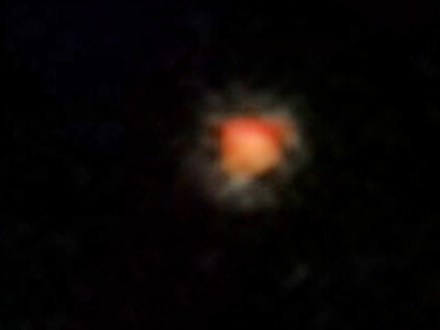
Betelguese DSC02443A

And later again about a month later the gas had become more even around the star.

Betelguese DSC02452A

As time went on into February 2014 we see that this gas eventually stabilised to cover most of the outside of the star .

Betelguse Feb 2014 DSC02892A

This demonstration shows that stars are very dynamic energy sources. Betelguese should never be trusted. It is a super giant nearing the end of its life and expected to go super nova at any time. When this happens at only 600 light years away will have an impact on earth by either lighting up the night sky to almost daylight or impacting communications around the world or affecting our outer layers of atmosphere temporarily or permanently.

By David Holland

Betelgeuse the red giant of Orion

Looking up into the night sky, I identified the constellation of Orion. Orion is  depicted in astrology as the mighty hunter.

The stars of orion are particularly interesting, not least a orange looking star at the constellations right arm.

This star is Betelgeuse, a red giant so massive that its diameter is similar to the orbit of Jupiter.

The star is approximately 640 light years away.

REcently I was able to take a photograph of this star with my Fuji camera. By sitting the camera on the tripod and selecting the multi focus option on the camera, I was able to zoom to the maximum the camera would zoom to and take the shot.

My camera has the ability to zoom to 30 times which is equivalent to having a 750mm lens. At this magnification the star was represented as a dot of light on the LCD screen.

Because I have 12 megapixels available to me on the camera, once on my PC iwas able to zoom in a further 800 times without extensive distortion and the photoograph below is the result.

Betelgeuse

As you are able to play around with the amount of light captured by the camera by altering the shutter speed, a faster shutter speed produced the following photo.  This shows that there is zones of higher and lower fusion activity on the surface of the star.

Betelgeuse High shutter speed


by David Holland

Link now available from Habitat Association for Arts and Environment web site

Gallery2020 Publishing’s site is now available from a link at habitatassociation.com.au.

This site is the primary site of the Habitat Association for the Arts and Environment (HAAE).

Gallery2020 Publishing’s continued relationship with HAAE is poised to help widen Gallery2020 Publishing’s exposure to the world by promoting papers and articles by Authors associated with both the Habitat Association and Gallery2020 Publishing.

Gallery2020 Publishing under the auspices of Habitat Association

Galley2020 was first founded in 2001. It was originally a business that provided a service for graphic art. Its services were the provision of business card designs and form design, book covers etcetra.

Later, the owner of the business decided to to write a book. At this time a new name was made for the business. The new name was Gallery2020 Publishing.

After many hours over a 2 year period the book was completed and published under the new publishing business. The name of the book is: ‘Will the Real Melchizedek please step forward’ authored by David Holland in December 2008.

We are hoping that this site will be able to display this book and other works from this author and other authors.

Gallery2020 publishing has decided to join with the Habitat Association for arts and environment and publish in collaboration with this association.

The Association is a non profit group that is interested in promoting writing,  publishing and the arts. As part of its phylosophy  it is interested in writers who wish to write about human environments and social interactions.  This means that it has a strong interest in promoting and mentoring all art forms as well as science as it is applied to human existance.

THe above example of one of Gallery2020 published books is clearly a book based on Biblical text and as such a theological book. Habitat assocation also has interestes in this field as it relates to human social environments.

Gallery2020 is proud to be associated with Habitat Association for Arts and Environment and recommend other publishers, arts organisations and education organisations interested in the human environment or habitat become associated with them.